

In the solar system, solar channel roll forming machines and strut channel roll forming machines are two common types of equipment. Both can continuously process steel coils into the profiles required for photovoltaic mounting structures; however, they differ significantly in terms of the number of forming stations, equipment structure, punching methods, the range of profiles produced, and changeover flexibility.
In this article, KINGREAL Roll Former provides a detailed overview of these differences to help manufacturers select the appropriate equipment based on factors such as material thickness, product cross-section, hole pattern requirements, and the nature of their order variations.
Differences Between Solar Channel and Strut Channel Roll Forming Machine
(1)Forming Stations and Profile Design
Solar channel roll forming machines and strut channel roll forming machines share the same fundamental forming principle. After being uncoiled, the metal strip is leveled and guided into a forming section composed of upper and lower roller shafts fitted with forming rollers.
Each forming station incrementally alters the angle of the material, ultimately shaping it into a stable profile. This gradual process prevents excessive localized stress and cross-sectional deformation that might otherwise occur if the profile were formed in a single step.
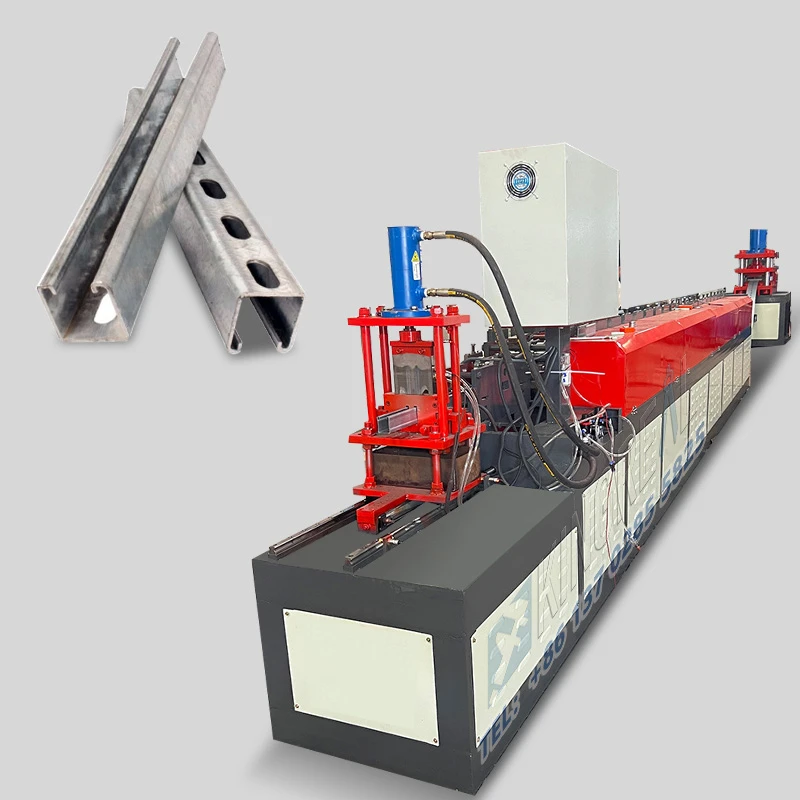
Solar channel roll forming machines are typically equipped with 14 to 20 forming stations and feature heavy-duty gearboxes, large-diameter rollers, and highly rigid machine frames. This equipment is primarily used to process galvanized steel or other structural steels with a thickness ranging from approximately 1.5 mm to 3.0 mm. Because thicker materials require higher forming torque and a more stable drive system, the motors, shaft diameters, bearings, and frame structures are specifically configured for continuous, heavy-load operation.
The primary products of solar channel roll forming machines are C channels, U channels, or custom-designed profiles used in large-scale PV systems. These profiles serve as rails, beams, and vertical posts, functioning to support PV modules, facilitate structural connections, and distribute loads.
The solar channel roll forming machine can be engineered to accommodate various specifications-such as C100, C150, and C200, or U41, U52, and U61-based on the required cross-sectional width, height, bending angles, and material thickness. The precision of the profile dimensions and hole positioning directly impacts the efficiency of the subsequent mounting structure assembly.
In contrast, a strut channel roll forming machine is typically configured with 10 to 16 forming stations, with an overall structure better suited for producing profiles of medium thickness and a wide variety of types.
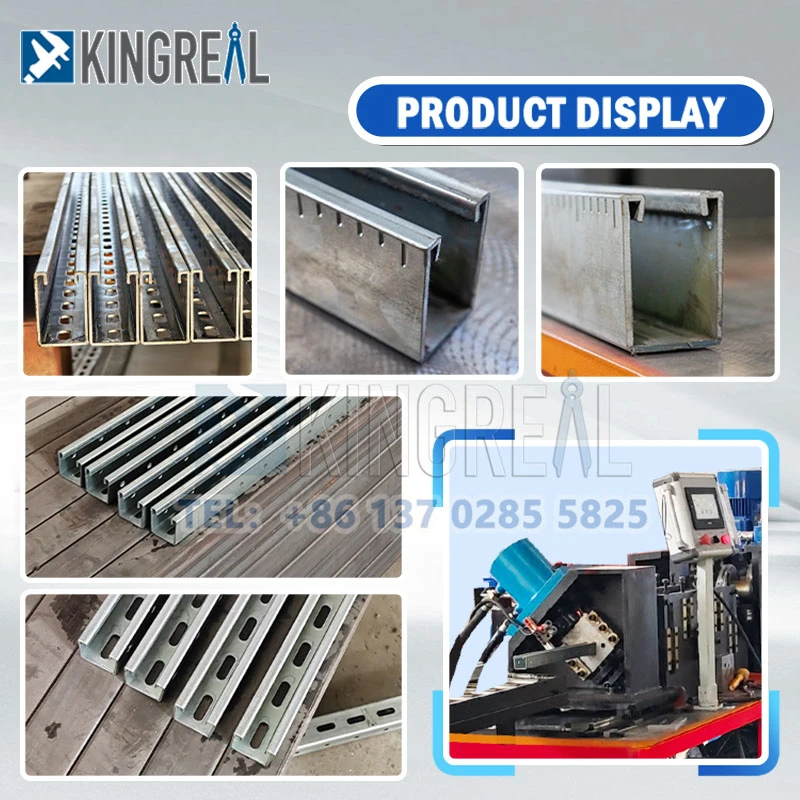
It can manufacture various configurations, including single slot, double slot, back to back channel, and open channels. By swapping out specific rollers, adjusting roller spacing, or utilizing multi-specification forming components, a strut channel roll forming machine can accommodate applications such as photovoltaic mounting systems, cable management, pipe supports, and industrial framing.
Consequently, a solar channel roll forming machine focuses more on processing thicker-gauge steel, ensuring continuous load-bearing capacity, and achieving the structural strength required for large-scale PV mounting systems; a strut channel roll forming machine, meanwhile, places greater emphasis on profile variety, hole configurations, and flexibility in product offerings.
(2)Punching Systems: Press Punching vs. In-line Punching
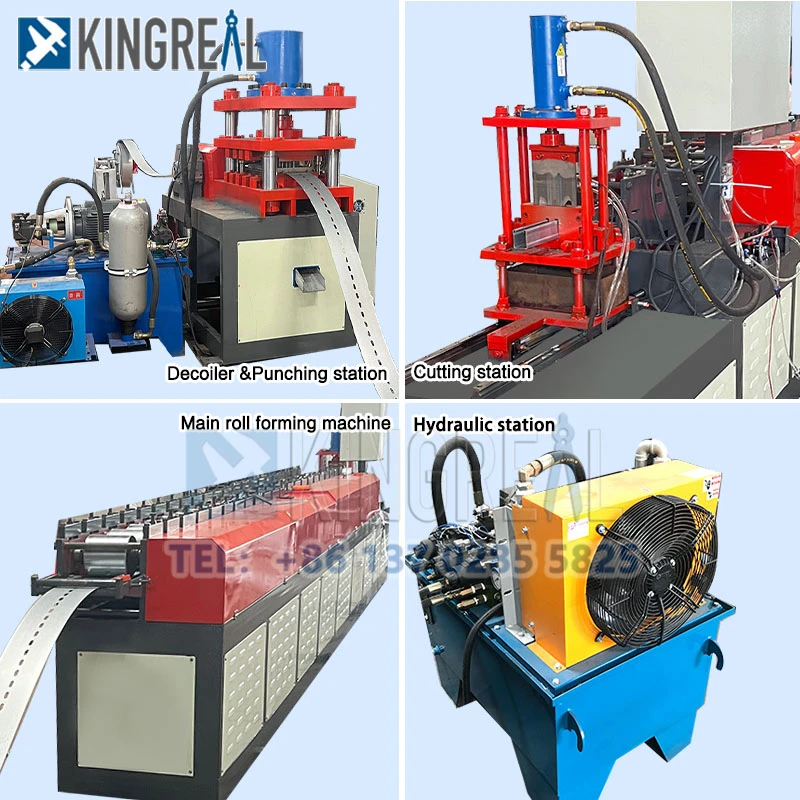
Solar channel roll forming machines typically utilize an in-line hydraulic punching system. The in-line hydraulic punching unit is controlled by a system comprising a PLC, encoders, position sensors, and hydraulic actuators. As the steel strip moves continuously, the control system calculates the precise timing for punching based on pre-set lengths and hole position data, ensuring that the punching action remains synchronized with the movement of the material.
This allows for hole processing without requiring the production line to come to a complete stop, thereby minimizing production delays caused by downtime.
In-line punching is well-suited for the various mounting, connecting, and combination hole patterns commonly found in solar energy systems. For projects requiring long, consistent hole spacing-or those involving multiple groups of holes on a single product-solar channel roll forming machines offer superior hole alignment accuracy. By modifying the PLC program and swapping out punching dies, the production line can be adapted to accommodate different hole pattern configurations.
While the initial setup and commissioning requirements are generally more demanding than those of a standard press-punching system, these machines are designed to meet the needs for continuous production, precise positioning, and customized punching.
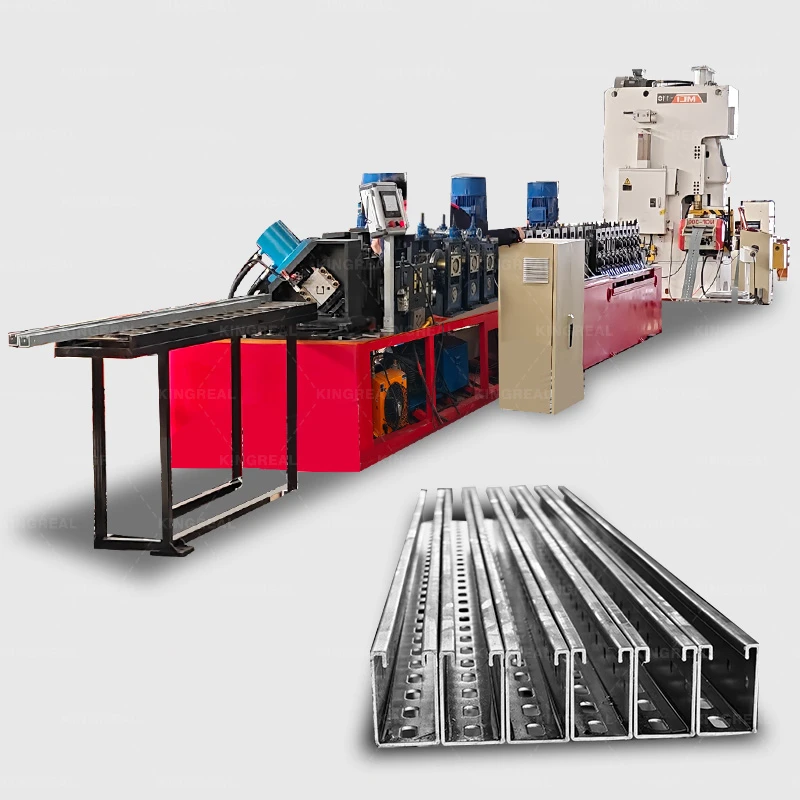
Strut channel roll forming machines typically employ a press punching system. A mechanical or hydraulic press-positioned either before or after the forming section-applies high-speed vertical force to punch holes or slots into the steel.
This type of press-based punching structure is relatively simple, with manageable equipment and maintenance costs, making it well-suited for standardized, highly repetitive hole patterns.
For instance, when a strut channel roll forming machine is dedicated to the long-term production of single slot, double slot, back to back channel or open channels with fixed widths and hole spacing, a press punching system can maintain a consistent production cadence. This approach is highly economical for production lines with limited product specifications and infrequent changes to hole patterns.
However, traditional press punching has certain limitations. Some presses require the steel strip to stop or decelerate for each stroke, meaning the punching cycle can constrain the overall line speed. Furthermore, any changes to hole spacing, length, width, or the arrangement of hole groups necessitate adjustments to the dies and control parameters. For production scenarios involving multiple batches, small order quantities, or frequent customization, the time required for die changes can reduce overall efficiency.
Therefore, while strut channel roll forming machines excel in high-speed, standardized production, configurations for complex hole patterns or continuous, dynamic punching must be tailored to the specific requirements of each project.
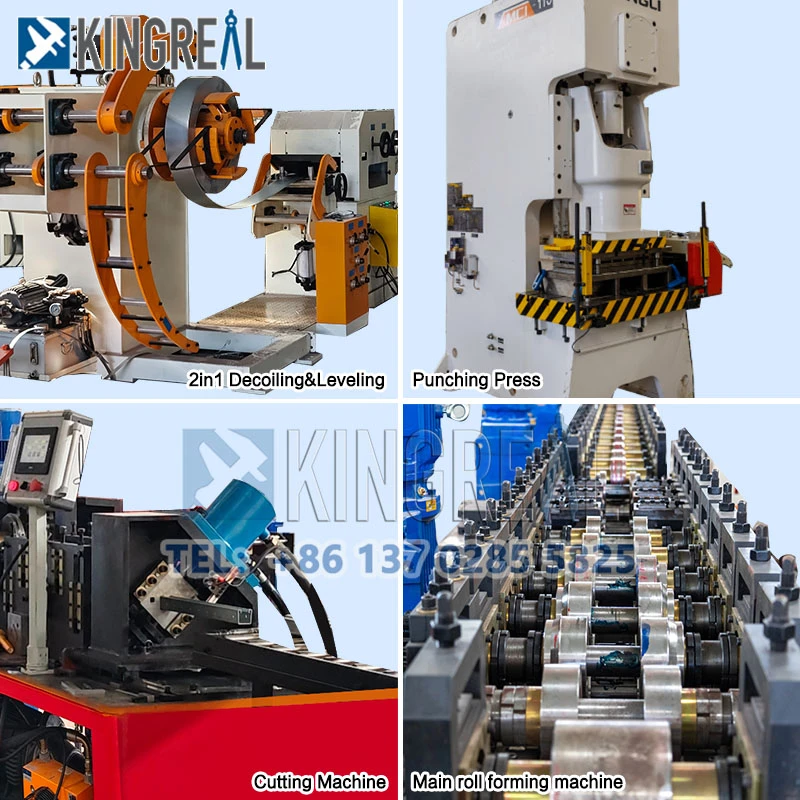
In short, the press-punching mechanism used in strut channel roll forming machines offers high speed, a straightforward design, and lower costs, making it ideal for fixed specifications and repetitive hole patterns.
In contrast, the in-line hydraulic punching system found in solar channel roll forming machines provides better continuity, higher positioning accuracy, and greater customization capabilities-making it the preferred choice for profiles that require high-precision mounting holes.
(3)Size Adjustment & Changeover Flexibility
In real-world manufacturing, producers often need to fabricate profiles with varying widths, heights, and hole patterns to meet specific customer orders. Consequently, the ability to adjust dimensions and switch between different profiles directly impacts equipment utilization. Both solar channel roll forming machines and strut channel roll forming machines can be equipped with adjustable forming roller stations.
Operators can modify the positions of the rollers-whether through manual adjustments, lead-screw mechanisms, or semi-automated systems-to accommodate different cross-sectional dimensions, thereby reducing the frequency with which entire sets of tooling need to be replaced.
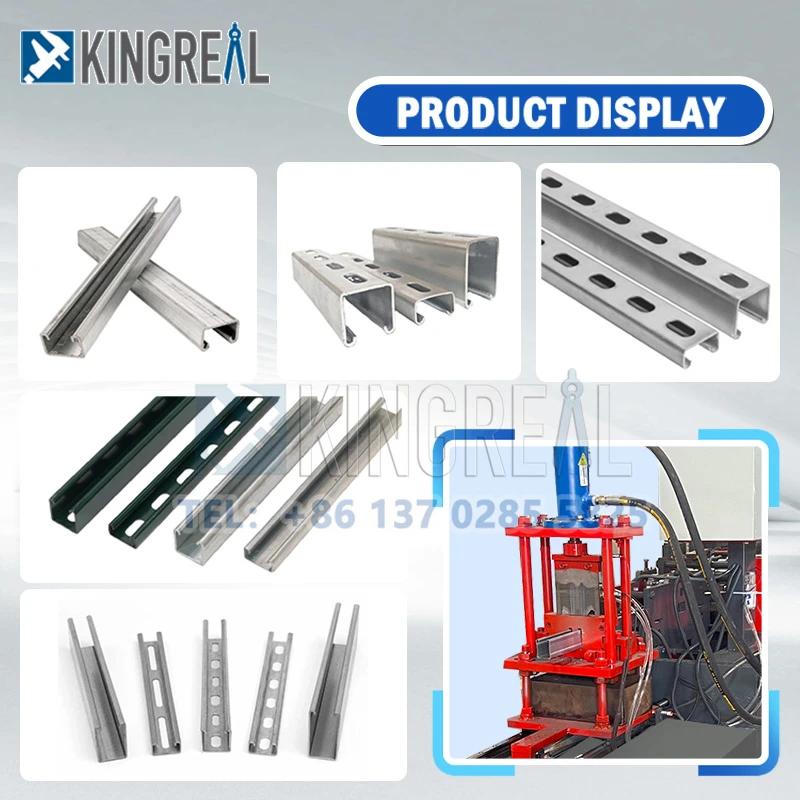
For solar channel roll forming machines, transitions between profiles such as C100, C150, C200, or various U channels can be achieved by adjusting forming parameters and swapping out specific components. With a well-engineered roller design, standard size changes can be completed in just a few minutes.
However, if there are significant variations in material thickness, bending angles, or cross-sectional geometry, it may still be necessary to replace certain rollers or punching dies.
Large-scale photovoltaic projects typically feature relatively standardized specifications; therefore, a solar channel roll forming machine is better suited for establishing a stable, continuous production process centered around core product types.
A strut channel roll forming machine, by contrast, generally offers greater adaptability across a diverse product mix.
Through the use of modular rollers, interchangeable punching dies, and independent guiding mechanisms, this equipment can be reconfigured to produce single slot, double slot, back to back channel, or open channels.
For manufacturers serving multiple sectors-such as PV, mechanical and electrical construction, and industrial support systems-a strut channel roll forming machine helps avoid redundant investment in separate production lines.
Its high changeover flexibility is ideal for environments characterized by frequent specification adjustments and variable order batch sizes.
How to Choose the Right Equipment?
If your operations focus on producing galvanized steel PV mounting structures with greater material thickness-specifically high-strength C channel or U channel -and you require high precision in hole positioning, superior structural rigidity, and consistent, continuous operation, then a solar channel roll forming machine is the better choice.
This is particularly relevant for large-scale ground-mounted power plants, agrivoltaic systems, and commercial rooftop installations, where consistent profile cross-sections and precise mounting holes significantly enhance on-site assembly efficiency.
Conversely, if your business centers on modular solar support systems, cable management, piping supports, or industrial framing-requiring frequent transitions between different cross-sections, hole patterns, and product configurations-a strut channel roll forming machine is generally more practical. Its integrated press-punching system is well-suited for standardized production, while its modular forming structure facilitates an expanded product range.
KINGREAL Roll Former offers customized design services for both solar channel and strut channel roll forming machines, tailored to your specific material requirements, profile cross-sections, hole patterns, production speed targets, and facility constraints.
Every aspect of the equipment-from uncoiling, leveling, forming, and punching to cutting, conveying, and automated control systems-can be configured to align with the specific needs of your project.
Please contact KINGREAL Roll Former directly for technical advice to determine the optimal production solution for your requirements.