

Chain drives and gearbox drives are two common transmission methods used in roll forming machines. Both configurations can transmit power to the forming rollers to facilitate the continuous shaping of metal sheets; however, they differ significantly in terms of transmission stability, material compatibility, production speed, equipment cost, and maintenance requirements.
Selecting the right roll forming machine requires more than just considering the price-it necessitates an evaluation of factors such as the product's cross-sectional profile, raw material thickness, material strength, production speed, and long-term capacity requirements.
For processing thinner or softer metal materials, a roll forming machine for chain drive is typically more cost-effective. These machines feature a lower initial investment and a straightforward design, making them well-suited for standard profiles and small-to-medium batch production.
Conversely, for high-strength or thicker materials, a roll forming machine for gearbox drive provides more stable torque across each forming station. This minimizes issues like slippage or uneven power distribution, making it better suited for continuous production and heavy-duty operating conditions.
Roll Forming Machines for Chain Drive
Working Principle
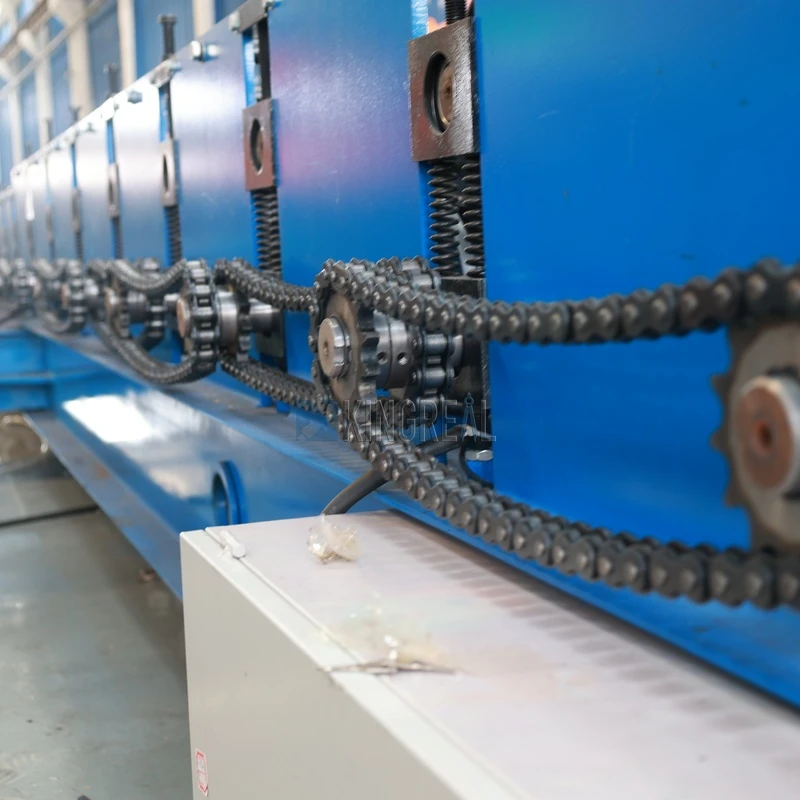
A roll forming machine for chain drive utilizes a motor, a speed reducer, sprockets, and high-strength chains to transmit power. Power is typically output from a main drive shaft and then distributed to individual forming roller stations via sprockets and chains. Each station operates synchronously at a set speed, allowing the metal sheet to enter the forming zone continuously and gradually take on the desired cross-sectional shape.
The chain-drive structure is relatively simple, making the manufacturing and installation process quite direct. For products involving thinner sheets and lower forming loads, a chain drive is sufficient to meet basic power transmission requirements. Some roll forming machines also incorporate protective shields, tensioning devices, and lubrication systems to optimize the performance of the chain drive.
Key Advantages of Chain Drives
Lower Initial Cost:
Because chains, sprockets, and related mounting components are relatively affordable, roll forming machines for chain drive are an ideal choice for small-to-medium-sized enterprises with limited budgets, as well as for operations investing in roll forming machine for the first time.
Straightforward Maintenance:
Chains and sprockets are standard mechanical components, with well-established procedures for inspection, tensioning, lubrication, and replacement. In the event of wear, there is generally no need to disassemble complex gearbox assemblies, resulting in relatively lower repair times and spare parts costs.
Suitable for lightweight materials:
When processing thin steel sheets, galvanized sheets, or other materials with low forming resistance, a chain-drive system can meet the production requirements of a standard roll forming machine. This configuration is particularly well-suited for projects involving infrequent profile changes and moderate production speeds.
Disadvantages of Chain Drive
Long-term operation may compromise precision.
Over time, chains can stretch, wear down, or experience changes in tension. If not adjusted promptly, the synchronization between the forming rollers may be disrupted, leading to dimensional deviations in the finished profiles.
Limited high-speed production capacity.
At high operating speeds, chains generate vibration, noise, and inertial fluctuations. When a roll forming machine is required to maintain high line speeds over extended periods, the demands on chain tension, lubrication, and installation precision increase significantly.
Requires regular adjustment and lubrication.
Inadequate maintenance can lead to transmission shocks, power loss, and abnormal wear. Consequently, operators must periodically inspect chain tension, the condition of the sprockets, and lubrication levels based on production duration and frequency of use.
Roll Forming Machines for Gearbox Drives
Working Principle
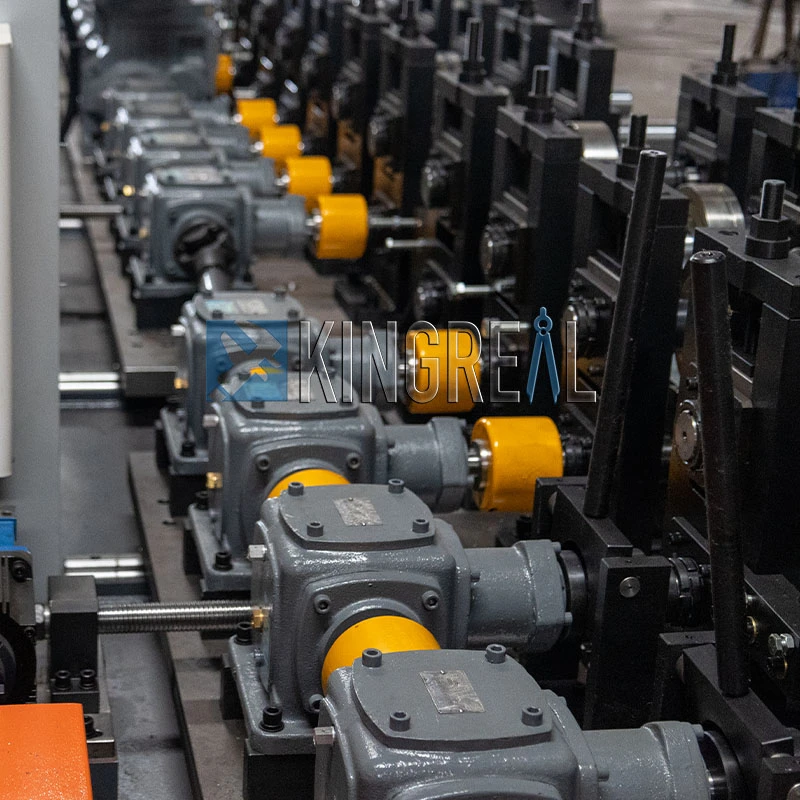
Roll forming machines for gearbox drive transmit power directly to each forming roller via precision gears, drive shafts, and gearboxes. A common configuration utilizes a dual-sided drive, ensuring that power is delivered to both ends of the forming rollers simultaneously. This setup ensures high synchronization between individual roller stations, maintaining stable speed and torque output throughout the continuous forming process.
Gearbox drives are ideal for applications requiring significant forming force. When processing high-strength steel, thick plates, or complex cross-sectional profiles, gearboxes minimize the risk of slippage during power transmission and optimize load distribution across the various forming stages. As a result, gearbox-driven roll-forming machines are typically employed for high-load, continuous production operations.
Advantages of Gearbox Drive
High transmission precision.
The meshing of precision gears minimizes backlash and slippage during power transmission, ensuring that the forming rollers maintain a highly stable relative positioning. For products with stringent requirements regarding hole positioning, edges, and complex cross-sections, a gearbox-driven system helps improve the dimensional consistency of the profiles.
Suitable for high-speed production.
When a production line requires high output and long periods of continuous operation, a gearbox provides a stable power output. A well-designed roll forming machine for gearbox drive can reduce downtime and the time spent on adjustments caused by uneven power transmission.
Suitable for thick plates and high-strength materials.
Gearboxes can deliver higher torque, making them ideal for processing thicker steel plates, stainless steel, or high-strength structural materials. Even when forming loads fluctuate significantly, a gearbox-driven system maintains superior operational stability.
Disadvantages of Gearbox Drive
Higher initial investment.
Because gearbox-driven systems require precision gears, drive shafts, bearings, and high-precision housings, the manufacturing cost and purchase price are generally higher than those of roll forming machines for chain drive.
More specialized maintenance requirements.
Gearboxes require regular inspection of lubricating oil, gear meshing, bearing temperatures, and transmission backlash. Improper maintenance can lead to abnormal gear wear and negatively impact the performance of the entire production line.
Greater impact of potential failures.
A gearbox serves as the power source for multiple forming stations; a serious malfunction can cause the entire roll forming machine to shut down. Companies must implement a structured maintenance plan and keep critical spare parts on hand to minimize repair time.
Choosing a Drive System for a Roll Forming Machine
When deciding between a chain driven and a gearbox driven, consider the following factors:
evaluate the material type and thickness
If the primary focus is on thin sheets, low-strength materials, or standard construction profiles, a roll forming machine for chain drive is usually sufficient.
If the materials are thicker, higher-strength, or feature complex cross-sections, a gearbox drive is more appropriate.
assess production speed and capacity
For small-to-medium batch sizes or intermittent production, a chain drive may be preferable.
For projects requiring high-speed, continuous operation over long daily shifts, prioritize the torque output and synchronization capabilities offered by a gearbox drive.
compare your budget and maintenance capabilities
For enterprises with limited budgets and basic in-house mechanical maintenance capabilities, a chain drive is a viable option. However, if a project demands higher levels of stability, precision, and long-term operational uptime, the costs associated with procuring a roll forming machine for gear drive-along with the expenses for professional maintenance-should be factored into the overall budget.
consider the product's precision requirements
For products with standard requirements regarding dimensional tolerances, hole-position accuracy, and cross-sectional consistency, a chain drive is generally sufficient. Conversely, for high-precision profiles, structural components, or projects requiring consistent, high-quality batch delivery, a gear-driven system offers better control over production tolerances.