

The tdc flange machine and tdf flange machines are the most common roll forming machines on the market for producing flanges for ventilation ducts. The flanges produced by tdc flange machine and tdf flange machine meet the technical specifications of the duct standards of major countries worldwide. The emergence of tdc flange machine and tdf flange machine has standardized and mass-produced rectangular duct production, offering advantages such as material savings, efficient installation, excellent sealing, and durability.
In construction projects, air conditioning systems play a vital role in ensuring indoor air quality. One of the key components of these systems is the air ducts, which transport clean, warm, or cool air to different parts of the building.
The two most commonly used types of ventilation ducts are TDF and TDC. Understanding the differences between TDF and TDC flange can help designers, implementers, and operators of construction projects make the best choice based on comprehensive knowledge.
KINGREAL Roll Former tdc flange machine and tdf flange machine are manufactured with optimized designs based on advanced international technology.
They utilize high-precision bearings, a heavy-duty chassis, rigid and rounded roller shafts, and specialized roller materials and heat treatment, resulting in high forming speeds and long roller life.
This article provides more information about tdc flange machine and tdf flange machine.
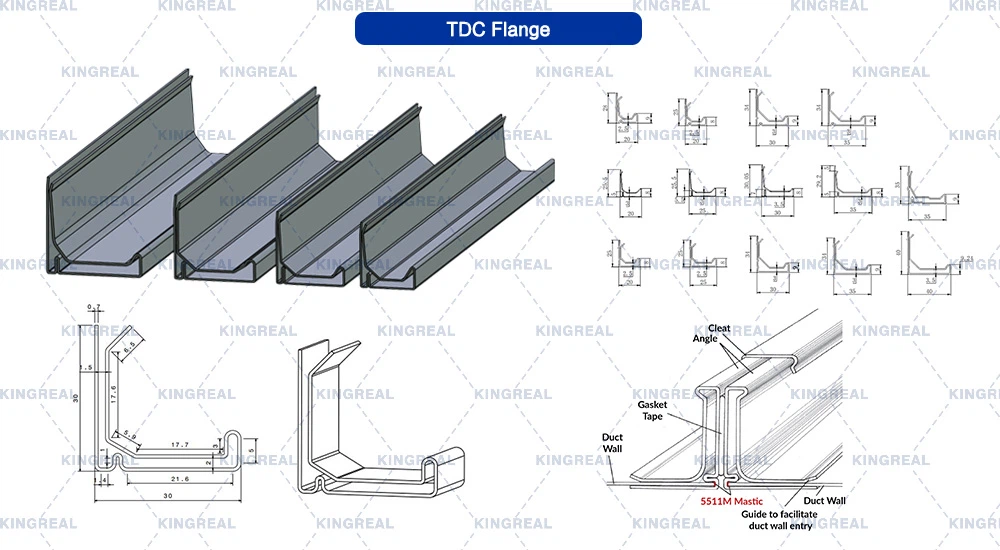
Various Solutions for TDC Flange Machine & TDF Flange Machine
●TDF flange machines:
KINGREAL Roll Former typically categorizes TDF flange machines into single-machine and dual-machine models, depending on job requirements. The single-machine models include the T-12 and T-15.
A single-machine tdf flange machine forms the flange on one side and the clip on the other. A dual-machine tdf flange machine, on the other hand, forms the flange on both sides simultaneously, saving time. Clips can be added as needed. A single-machine tdf flange machine is easier to move than a dual-machine tdf flange machine.
Furthermore, the single-machine tdf flange machine is popular on-site for its stability and portability. It is lightweight and can be easily moved using its wheels.
This tdf flange machine is part of a rectangular ventilation duct manufacturing system, allowing operators to combine it with other machines to complete the production of a complete duct system.
●TDC flange machine:
TDC flanges are classified into five types based on their performance, strength, and sealing level: T-20, T-25, T-30, T-35, and T-40.
For this reason, KINGREAL Roll Former has designed the following tdc flange machines for these purposes (one set of equipment can produce one specification):
A single TDC flange machine can be divided into five models based on processing requirements: T-20, T-25, T30, T35, and T40. These tdc flange machines automatically form TDC flanges and automatically feed the sheet material during processing.
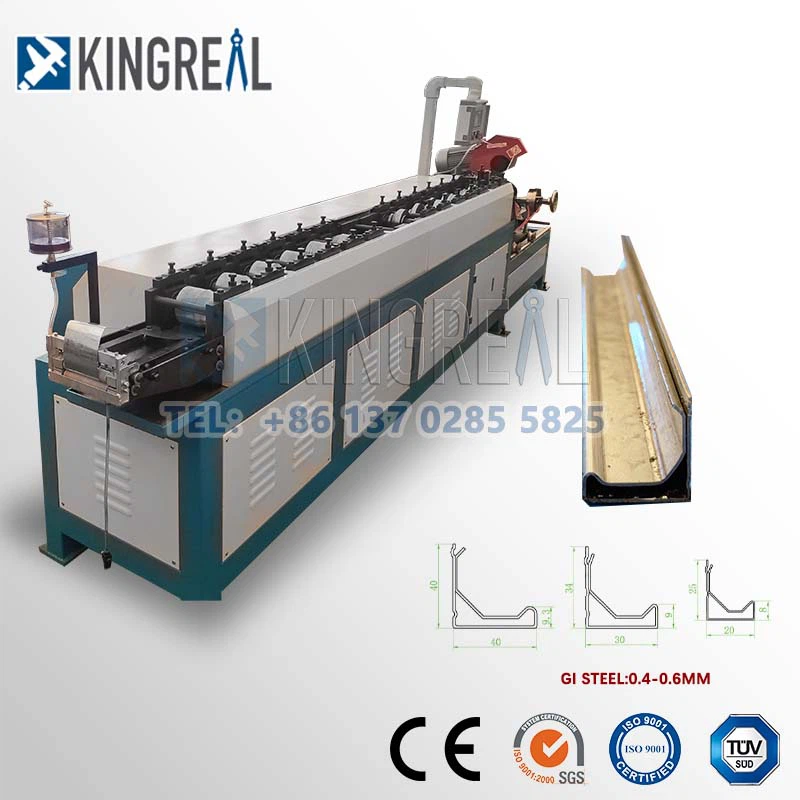
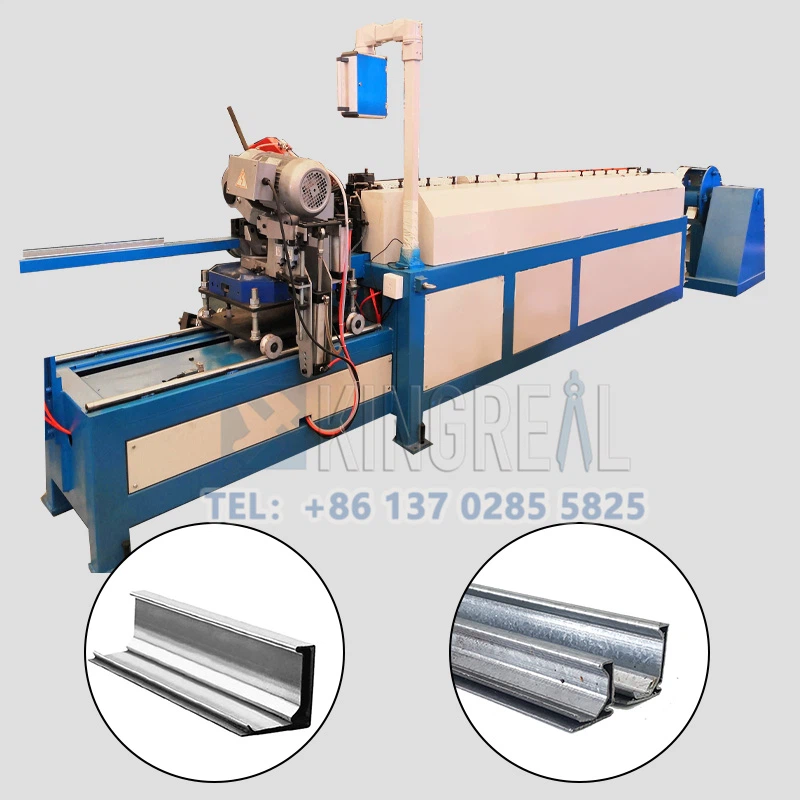
The general parameters of the tdc flange machine are as follows, which can be adjusted based on the customer's specific needs:
(1)T-20 tdc flange machine
sheet thickness range: 0.5 mm and 0.8 mm,
overall dimensions: 4900 × 1020 × 1540 mm,
weight: 2200 kg,
main motor power: 3 kW,
cutting unit power: 2.2 kW, determined by the length of the raw material.
T-25 tdc flange machine
sheet thickness range: 0.5 mm and 1.0 mm,
dimensions: 5500 × 1020 × 1540 mm,
weight: 2500 kg,
main motor power: 3.0 kW,
cutting unit power: 2.2 kW.
T-30 tdc flange machine
sheet thickness range: 0.5 mm and 1.0 mm,
dimensions: 4820 × 1020 × 1540 mm,
weight: 2200 kg,
main motor power: 3 kW,
cutting unit power: 2.2 kW.
T-35 tdc flange machine
sheet thickness range: 1.0 mm to 1.0 mm,
dimensions: 5550 × 1020 × 1540 mm,
weight: 3000 kg,
main motor power: 3 kW,
cutting unit power: 2.2 kW.
T-40 tdc flange machine
sheet thickness range: 1.2 mm,
dimensions: 4900 × 1020 × 1540 mm,
weight: 3400 kg,
main motor power: 4 kW,
cutting unit power: 2.2 kW.
Differences Between Finished Products Produced By TDC Flange Machine & TDF Flange Machines
(1)TDC flange and tdf flange produced by tdc flange machine and tdf flange machines have distinct differences.
●TDF stands for "transverse pipe flange." This type of pipe is made with an integral flange formed at the end of the pipe. In effect, the edge of the pipe is directly connected to the next pipe via the flange. This system eliminates the need for separate flanges, which are typically formed using a dedicated rolling machine.
●TDC stands for "transverse pipe connector." Unlike TDF, this connection method uses separate flanges that are first attached to the pipe and then secured to the next pipe using bolts or clamps. TDC flanges are typically made of galvanized steel and attached to the pipe using a stamping machine at the manufacturing site.
(2)Comparison of TDF and TDC Flange Structures
2.1 Physical Structure
TDF piping is manufactured with integral flanges at the edges, eliminating the need for separate assembly components. TDC piping, on the other hand, requires the installation of separate flanges at each end of the pipe, which is more time-consuming.
2-2 Joint Strength
In many cases, TDC piping offers greater mechanical strength due to the use of metal flanges and separate fasteners. This feature makes it particularly suitable for systems with high internal pressures.
2-3 Lightweight
Because of the elimination of redundant components, TDF piping is lighter than TDC piping, an advantage for projects focused on light-weighting.
2-4 Speed of Installation
TDF piping is faster to install because it does not require separate flanges, which is crucial in time-sensitive projects.