

Roll forming is a continuous process that transforms sheet metal into an engineered shape using successive sets of paired rolls, each making only incremental changes to the form. The sum of these small changes in form is a complex outline.

Process of Roll Forming Machine:
In conventional stamping, the entire part is formed at the same time. When the resulting strain exceeds what the metal can achieve before it splits, the shape of the part and especially how complex it can be.
In roll-formed parts, only a small amount of forming strain is applied to the part during each station, and even here, only a small amount is bent at any given time. Therefore, more complex shapes can be achieved with a properly designed roll forming process.

During the forming process, a roll or strip is fed into a roll forming line that transforms the flat sheet into a contoured cross-sectional profile. Unique to this method is the use of successive forming stations, each of which pushes the metal into the desired shape. Based on the target profile, the computer calculates the optimal position and shape of the rollers for maximum efficiency and designs the track.
The more advanced the desired shape, the more rolls the material passes through. Roll forming lines bend metal, form it into tubes, create a metal labyrinth, and punch holes in the metal in the process.
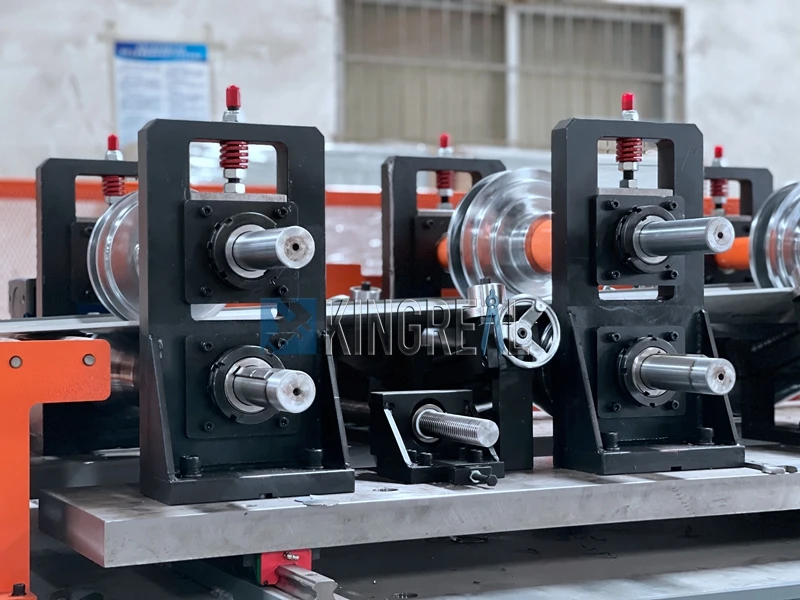
Rollers are precision contoured metal molds used to shape incoming sheet metal. In most cases, they are also powered rollers that pull the strip through the roll forming unit.
These rollers can be as simple as the cylindrical roller used to roll luggage through airport scanners, or they can take on more complex shapes. After the final forming station, the strip is cut to the ordered product length. Usually, no additional work is required before shipment because the final form is already done.